Oct 8, 2026
UV Germicidal Lamp Tube Diameter Guide for OEM Buyers
Compare UV lamp tube diameters and learn how outside diameter affects quartz sleeve fit, lamp holders, ballasts, thermal design and OEM approval.
UV germicidal lamp tube diameter is easy to overlook because buyers often start with wattage, total length and base type. For an OEM project or replacement order, however, the outside diameter of the quartz tube can decide whether the lamp fits the holder, enters the quartz sleeve, maintains the required clearance and operates correctly inside the equipment.
This guide explains how overseas equipment manufacturers, distributors and service teams should compare common UVC lamp tube diameters before approving samples or placing a repeat order. It applies to water sterilizers, air disinfection units, HVAC systems, surface treatment equipment and other UV-C devices.
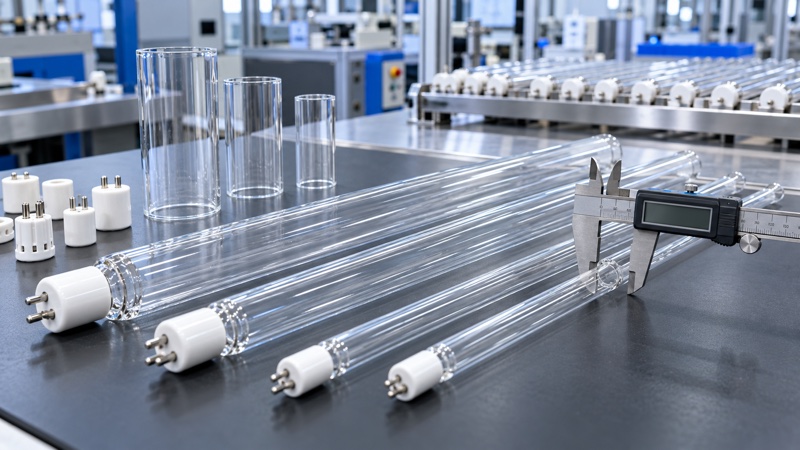
Why UV Lamp Tube Diameter Matters
The tube diameter is not only a physical dimension. It affects mechanical installation, thermal conditions, electrical lamp design and the amount of space available around the lamp. A tube that is only a few millimeters wider than the original may interfere with a sleeve, clip, reflector or housing. A narrower tube may fit loosely in the holder or require a different lamp construction to deliver the specified operating characteristics.
When sourcing UV germicidal lamp tubes, buyers should treat outside diameter as a controlled specification together with total length, arc length, wattage, wavelength, base and pin layout.
Common Diameter Ranges for Germicidal Lamps
Linear UV-C lamps are manufactured in several diameter families. Buyers may encounter nominal tube diameters around 15 mm, 19 mm, 25 mm or other custom sizes, depending on the lamp power, manufacturer and equipment platform. These values are useful for initial classification, but they should not replace an approved drawing or direct measurement.
| Diameter consideration | Typical buyer concern | Verification method |
|---|---|---|
| Nominal outside diameter | Will the lamp fit the existing sleeve and holder? | Measure the old lamp with a caliper and compare the supplier drawing. |
| Manufacturing tolerance | Can every production lamp pass through the available opening? | Confirm maximum outside diameter and inspect samples from the intended production process. |
| End-area geometry | Does the sealed end or base create a larger local diameter? | Check the complete lamp, not only the straight center section. |
| Clearance around the tube | Is there enough room for installation, expansion and service removal? | Test the lamp in the real sleeve, clip and equipment assembly. |
Match the Lamp Diameter to the Quartz Sleeve
In water disinfection systems, the lamp usually operates inside a quartz sleeve. The sleeve inside diameter must be larger than the lamp’s maximum outside diameter, including any local variation near the sealed ends. At the same time, excessive clearance may change the original reactor geometry and make centering or service handling more difficult.
For replacement projects, send the old lamp diameter and the sleeve inside diameter whenever possible. If the sleeve information is incomplete, review the quartz sleeve product options and provide clear photographs of the reactor, sealing end and removed components. Diameter, sleeve length, wall thickness and O-ring position should be checked as one assembly.
Do not use the sleeve outside diameter as the lamp clearance
A common purchasing error is to compare the lamp diameter with the sleeve outside diameter. The lamp fits inside the sleeve, so the critical value is the sleeve inside diameter and its tolerance. Deposits, deformation, closed-end geometry and installation fittings can further reduce usable clearance.
Check Lamp Holders, Clips and Base Geometry
The lamp base and the glass tube are separate matching points. Two lamps may use a similar pin arrangement while having different tube diameters, or they may share a tube diameter but use incompatible bases. Clips designed to support the glass may also be diameter-specific.
Before approving a replacement, compare the base code, pin spacing, pin orientation, cap dimensions and tube support method. BIOSUN’s UV lamp holders and accessories can be evaluated together with the lamp, while the base type and pin layout matching guide provides a practical checklist for unidentified models.
Diameter Does Not Determine Wattage by Itself
A wider tube does not automatically mean a higher-wattage lamp, and two lamps with the same outside diameter are not necessarily electrically interchangeable. Lamp length, electrode design, gas fill, operating current, voltage and ballast characteristics all contribute to the final lamp specification.
For this reason, a mechanically fitting lamp should not be connected to the existing power supply until its electrical data have been confirmed. Buyers should compare the lamp specification with the UV electronic ballast output and follow the checks in the operating current and ballast compatibility guide.
How Diameter Influences OEM Equipment Design
Available installation space
Compact air purifiers, appliances and duct modules often have limited room around the lamp. The designer must consider the tube, base, connector, reflector, guard and wiring bend radius. The maximum outside diameter should be included in the mechanical drawing, not left as an approximate catalog value.
Thermal conditions
Tube diameter can be associated with a different lamp construction and operating temperature profile. OEM teams should test the selected lamp in the actual airflow, enclosure and duty cycle. A sample that works on an open bench may behave differently inside a warm, restricted housing.
Optical layout and reflectors
Changing tube diameter can alter the lamp centerline relative to a reflector or treatment zone. In a validated product, this may affect the distribution of UV energy even if the replacement lamp appears to fit. Keep the original optical geometry unless the system is being revalidated.
Maintenance access
Equipment should allow technicians to remove the lamp without forcing the quartz tube through a tight clip or contaminated sleeve. Adequate service clearance reduces breakage risk and makes scheduled lamp replacement more practical.
Buyer Measurement Checklist
When a model number is unavailable, prepare the following information before requesting a quotation:
- Tube outside diameter measured at several positions
- Total lamp length, excluding and including pins where relevant
- Arc length or illuminated section length if known
- Base type, pin count, pin spacing and connector photographs
- Lamp wattage, voltage or current markings
- Ballast label and wiring diagram
- Quartz sleeve inside diameter, outside diameter and total length
- Equipment brand, model and application
- Ozone-free or ozone-generating requirement
- Required quantity and whether the order is for service stock or OEM production
For an existing installation, start with the replacement UVC lamp range and send photographs next to a ruler or caliper. Clear evidence is more reliable than estimating diameter from a product name.
Sample Approval Before Mass Production
OEM buyers should approve the lamp in the real equipment before releasing a production order. The sample check should cover dimensional fit, base engagement, sleeve clearance, startup, stable operation, ballast temperature, lamp temperature, output monitoring and service removal.
Record the approved diameter and tolerance in the controlled specification. Keep photographs and a signed sample when possible. The UV lamp sample approval guide explains how to document these checks for repeat-order consistency.
Common Purchasing Mistakes
- Ordering by wattage and length without checking tube diameter
- Assuming every lamp with the same base uses the same glass size
- Comparing the lamp with the sleeve outside diameter instead of inside diameter
- Ignoring the maximum diameter near sealed ends
- Approving mechanical fit without checking ballast compatibility
- Changing lamp diameter in a validated reactor without performance testing
- Using one sample measurement as the production tolerance
FAQ About UV Germicidal Lamp Tube Diameter
Can I replace a 15 mm UV lamp with a 19 mm lamp?
Only if the equipment has sufficient mechanical clearance and the new lamp is electrically and optically validated for the system. In most replacement projects, maintaining the original diameter is the lower-risk choice.
Is the diameter printed on the lamp?
Usually the lamp marking focuses on model and wattage, so diameter may need to be measured or confirmed from the manufacturer’s drawing. Measure the glass with a suitable caliper and avoid excessive pressure.
Does a larger tube produce more UV output?
Not necessarily. UV output depends on the complete lamp design and operating conditions. Tube diameter alone is not a reliable indicator of power or germicidal performance.
What tolerance should be used for an OEM drawing?
The correct tolerance depends on the lamp construction and supplier process. Ask the manufacturer for the maximum and minimum values they can control, then confirm that the equipment works across that range.
Send BIOSUN Your Lamp Dimensions for Matching
For replacement or OEM selection, send BIOSUN the lamp model, tube diameter, total length, base photographs, ballast label, quartz sleeve dimensions and equipment application. The team can compare the mechanical and electrical requirements and prepare samples for validation.
For customized lamp lengths, bases or production labeling, review the BIOSUN OEM and ODM service. To request model matching or a quotation, use the BIOSUN contact page and attach the available measurements and photographs.
Need a UV product quotation?
Send the model, drawing, application and expected quantity. BIOSUN will review the matching details and reply by email.
Send Inquiry