9 月 8, 2026
UV Lamp Operating Current and Ballast Compatibility Guide for B2B Buyers
Learn how to match UV lamp operating current, voltage, wattage and ballast output before approving replacement or OEM UVC lamp orders.
When an overseas buyer replaces a UV lamp, matching only the length, wattage and base can still lead to unstable operation. The lamp operating current must also match the ballast output and circuit design. This guide explains how OEM buyers, distributors and service teams can compare UV germicidal lamp tubes with the correct electrical driver before approving samples or placing a bulk order.
Why UV lamp operating current matters
A UV lamp and its ballast work as one electrical system. The ballast starts the discharge inside the lamp and then controls the current during operation. If the current is outside the lamp’s intended range, the system may show difficult starting, flicker, unstable output, overheating or shortened service life. A lamp that physically fits a reactor can therefore still be electrically incompatible.
This is especially important for replacement UVC lamps. Two models may have similar dimensions and nominal wattage but use different operating currents, electrode designs or starting conditions. Buyers should confirm the original lamp and ballast data instead of selecting a substitute from appearance alone.
Separate the three electrical values in a UV system
Mains input to the ballast
The mains input is the power supplied to the ballast, such as the rated voltage and frequency of the installation. It is not the same as the current flowing through the UV lamp. When equipment is exported to different markets, the input range of the UV electronic ballast must match the local power supply.
Ballast output to the lamp
The ballast output is designed around a specific lamp load. Relevant values may include lamp operating current, lamp voltage, starting method, output frequency and supported wattage range. These values should be checked against the lamp manufacturer’s specification or the approved original system.
Nominal lamp wattage
Nominal wattage is useful for identifying a lamp family, but it does not fully define electrical compatibility. Buyers should use a complete data set rather than treating wattage as the only selection parameter. The fields in the UV lamp specification sheet checklist provide a practical starting point.
UV lamp and ballast compatibility checklist
1. Confirm the exact lamp model
Record the full model code printed on the lamp, including any suffixes. Also measure total length, arc length and tube diameter. A suffix can indicate a different base, output level, ozone characteristic or electrical design, so it should not be omitted from an RFQ.
2. Compare lamp operating current
Ask for the rated operating current in milliamperes or amperes and confirm the permitted tolerance. Do not estimate it from the mains-side current of the ballast. If the original value is unavailable, provide clear photos of the lamp marking, ballast label and wiring diagram so the supplier can evaluate the complete system.
3. Verify lamp voltage and power
Lamp voltage and current together help identify the electrical load expected by the ballast. A replacement should be reviewed against both values where data is available. For high-output or amalgam UV lamps, the supplier may also need information about warm-up behavior, cooling and the operating environment.
4. Match the base, pins and wiring
Electrical compatibility does not remove the need for a mechanical check. Confirm the base type, pin count, pin spacing, cable length and connector arrangement. Use the UV lamp base and pin layout guide to organize photos and dimensions before sample production.
5. Check starting and protection functions
Some electronic ballasts include lamp-failure detection, end-of-life protection, alarm contacts or automatic restart logic. These functions can affect how a replacement lamp behaves in the equipment. OEM buyers should document required control signals and connector pin assignments, not only the lamp power.
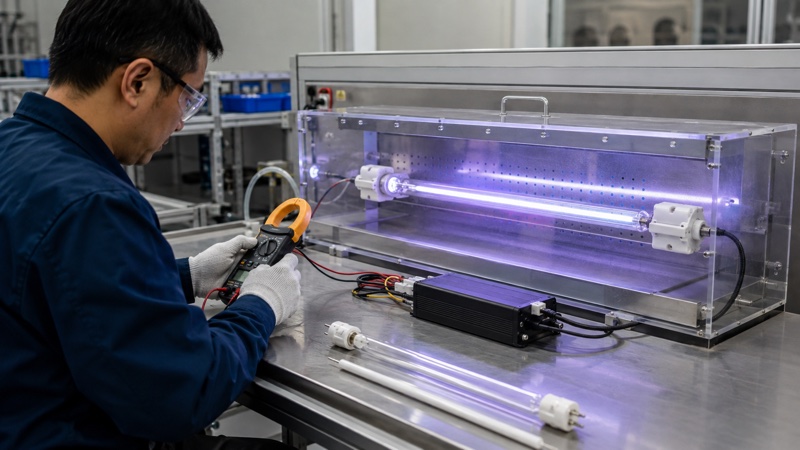
Common signs of an electrical mismatch
A mismatched lamp and ballast may fail immediately, but some problems appear only after warm-up or repeated starts. Typical warning signs include:
- The lamp does not ignite or requires several attempts.
- The lamp flickers, cycles on and off, or runs at visibly unstable brightness.
- The ballast becomes unusually hot or enters protection mode.
- The lamp ends darken faster than the approved reference sample.
- Measured UV intensity is below the expected level even though the lamp is illuminated.
These symptoms are not proof of one specific fault. Wiring, lamp age, contaminated contacts, ambient temperature and ballast condition can produce similar results. The UV lamp troubleshooting guide helps service teams separate common causes before replacing parts.
A practical replacement verification workflow
Step 1: Collect original system information
Photograph the lamp marking, ballast label, connector and installation position. Record the equipment model, supply voltage, application, operating hours and any alarm code. If a quartz sleeve is used, include its dimensions because the sleeve affects the mechanical installation and operating temperature. BIOSUN supplies matching quartz sleeves for UV water systems where required.
Step 2: Compare the proposed replacement data
Create a side-by-side table covering lamp model, wattage, voltage, operating current, dimensions, base, pins, wavelength and ballast model. Any unknown field should be marked for confirmation rather than assumed to be equivalent.
Step 3: Test a sample with the intended ballast
Run the proposed lamp on the actual ballast or a validated equivalent. Check ignition, stable current, warm-up behavior, ballast temperature and alarm functions. The UV lamp sample approval guide explains how to document the reference sample before bulk production.
Step 4: Approve the lamp and ballast as a pair
The final approval record should identify both model numbers. This prevents a later purchasing team from ordering an approved lamp with an unverified ballast. For service kits, include the correct holders, cables and UV lamp accessories in the same bill of materials.
Information to include in an OEM or replacement RFQ
A complete RFQ reduces sample revisions and shortens technical confirmation. Include the following information when available:
- Original UV lamp model and clear marking photos.
- Ballast model, label photo and wiring diagram.
- Input voltage and frequency of the equipment.
- Lamp wattage, voltage and rated operating current.
- Total length, arc length, tube diameter, base and pin layout.
- Application, operating temperature, airflow or water-system conditions.
- Required quantity, private label needs and target delivery schedule.
If some electrical values are missing, send the information that is available through the BIOSUN UV lamp inquiry page. The technical team can use the original model, photos and application details to identify the next verification steps.
FAQ
Can two UV lamps with the same wattage use the same ballast?
Not always. Matching wattage is only one condition. Operating current, lamp voltage, starting requirements and the ballast’s supported lamp load must also be compatible.
Is ballast input current the same as lamp operating current?
No. Input current is measured on the mains side of the ballast, while lamp operating current is controlled on the output side. They should be listed as separate specifications.
Can a wrong ballast damage a UV lamp?
An incompatible ballast can cause failed starting, unstable operation, overheating or accelerated electrode wear. The lamp and ballast should be tested together before bulk approval.
What should I do if the original ballast label is unreadable?
Provide the equipment model, wiring photos, connector details, original lamp code and any available service manual. A controlled sample test may be required before confirming a replacement.
Confirm UV lamp and ballast compatibility with BIOSUN
BIOSUN supports overseas equipment manufacturers, distributors and service companies with UV lamp model matching, electronic ballast selection, sample verification and OEM labeling. Send the original lamp and ballast information through the contact page for a practical compatibility review before ordering.
Need a UV lamp quotation?
Send your model list to Baiousen and we will review the lamp matching details by email.
Send Inquiry