
Nov 18, 2026
How to Select UV Germicidal Lamp Tubes for OEM Equipment
Select UV germicidal lamp tubes by application, base, dimensions and wattage. Compare water treatment, kitchen exhaust, HVAC and compact OEM designs.
BIOSUN lists two straight tubes with a G13 base, a catalogue length of 380 mm and a 15 mm tube diameter. One is rated 14 W and the other 15 W. Signify offers two compact lamps with the same nominal 9 W designation, one with two pins and one with four. Before ordering, check whether the proposed lamp fits the equipment, connects to the holder, matches the ballast and provides the specified spectral version. BIOSUN lamp catalogue · Signify compact lamp family leaflet
Replacing an existing lamp? Start with the original part number, equipment model and ballast label. Developing new equipment? Start with the application and installation space. The lamp base is the physical and electrical interface between the tube and its holder. Record it separately from the power rating.
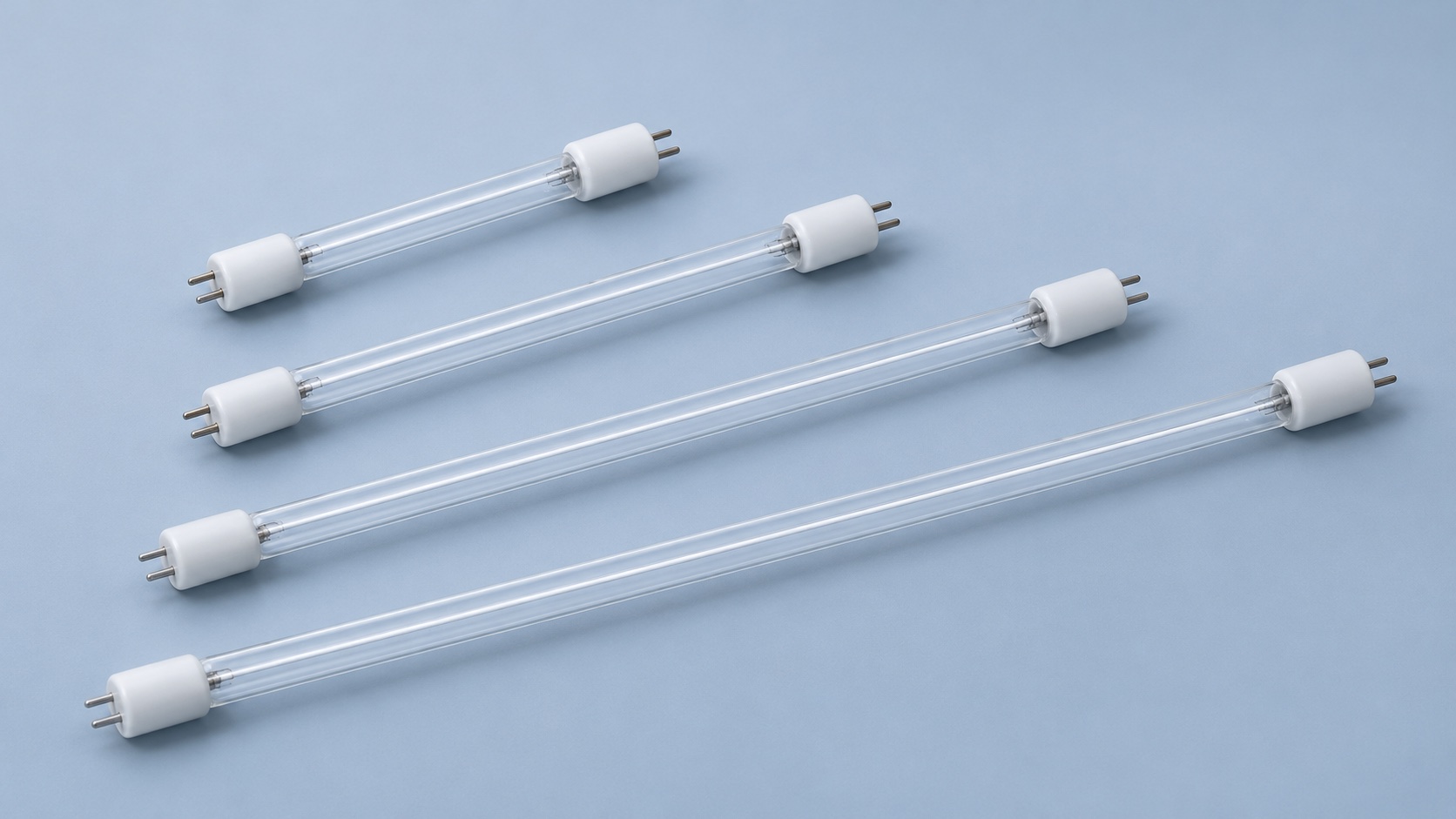
Start With the Equipment and Application
| Equipment | Lamp types to shortlist | What to check first |
|---|---|---|
| Commercial water reactor | Start with a straight tube if the reactor has a long sleeve and room to withdraw the lamp. Compare high-output low-pressure or amalgam lamps where the system calls for higher output. | Original part number, sleeve bore and usable depth, withdrawal clearance and specified driver. For new equipment, provide the design flow and water conditions. |
| Commercial kitchen hood or exhaust equipment | Consider a long straight lamp where the rack has enough length. Industrial exhaust assemblies can also use U-shaped lamps designed around the rack. | Original spectrum and ozone requirement, rack geometry, base or connector, and specified ballast. Match the finished equipment documentation. |
| Commercial HVAC coil or duct | Start with a linear low-pressure lamp where the layout runs along a coil or duct. | Establish whether the equipment treats a coil surface or moving air. Then check mounting position, available space and operating conditions. |
| Compact purification module or enclosed compartment | Compare compact H-shaped lamps for shallow compartments serviced from one side. Consider a miniature cold-cathode U-shaped lamp for a small OEM module. | Check overall width and base orientation for an H-shaped lamp. Check leads, connector, mounting and driver for the cold-cathode lamp. |
Water treatment example. The TrojanUV3000Plus municipal wastewater system uses amalgam lamps in a horizontal arrangement and lists 250 W of input power per lamp. For a replacement in this type of equipment, use the reactor model and original lamp reference to identify the lamp, sleeve assembly and driver. For a new installation, a catalogue option such as the BIOSUN BOS-HCL-75W-1554 (75 W, 1,554 mm listed length, G13) illustrates a long straight candidate to check against the sleeve and driver drawings. A system’s flow rating requires its own evidence. VIQUA’s breakdown of standard and high-output lamps gives buyers a starting point for comparing the available platforms against the design conditions. BIOSUN linear catalogue · Trojan system specifications · VIQUA UV system components
Kitchen exhaust example. Halton’s hood datasheet lists a 41 W short lamp and a 75 W long lamp. Both are listed at 425 mA, but their lamp voltages are 120 V and 220 V respectively, and the connectors are specified for Halton. The dimensions used to distinguish the short and long versions are hood lengths. Check the lamp drawing for the lamp dimension. Noblelight also documents a dedicated 185 nm application for kitchen grease and odor control. For exhaust equipment, confirm both the mechanical fit and the spectrum in the equipment’s approved specification. Halton UV hood datasheet, printed page 121 · Noblelight kitchen exhaust application
ASHRAE distinguishes coil-surface treatment from airstream disinfection. A coil-focused layout may have limited air-disinfection capability. For compact OEM designs, BIOSUN’s H-shaped and miniature cold-cathode product groups provide starting points to compare with the host equipment drawing. ASHRAE Handbook: Ultraviolet Air and Surface Treatment · BIOSUN lamp groups
Identify the Base and Photograph Both Ends
Read the code on the existing lamp or socket. Photograph the front and side of each end. Record whether the contacts are split between the two ends or grouped at one end. For a single-ended lamp, show the pin layout and any keying feature. For a lamp with leads, show both sides of the connector and include lead dimensions.
For example, Philips TUV PL-S 9W/2P uses a G23 base, while TUV PL-S 9W/4P uses 2G7. An inquiry for a “9 W compact lamp” leaves out the interface the buyer needs to identify. Once the base is confirmed, use the model data to check the ballast and electrical connections. Signify family leaflet, cap-base table
Put the Measurement Points on the Drawing
- Linear lamps. Record overall length including the pins, the distance between the base faces and the glass outside diameter. If an arc length is specified, record it separately. In a water reactor, check the sleeve’s bore and usable depth along with the room needed to withdraw the lamp.
- H-shaped and U-shaped lamps. Record maximum width, overall height, leg center spacing and the direction of the base or leads. Maximum width and connector clearance can decide whether the part fits a compact compartment.
- Replacement requests. Mark the measurement endpoints on a photograph. If a quotation shows only one length, ask the supplier to mark that dimension on the drawing.
LightSources’ catalogue distinguishes base-face length, arc length, overall length and outside diameter. Use a catalogue length to shortlist a lamp, then use the model drawing to confirm the installation dimensions. LightSources lamp catalogue and dimension fields
Check Electrical Wattage, Ballast and UV-C Output
Use the rated lamp wattage together with the lamp operating current, operating voltage, starting method and ballast model. If the purchase specifies optical performance, ask for the UV-C output and its measurement conditions. One Philips TUV T8 datasheet lists 30 W of electrical power consumption and 12.3 W of UV-C radiation at 100 hours as separate values. Signify TUV T8 product specifications
| BIOSUN catalogue model | Construction | Base | Catalogue length | Tube diameter | Catalogue power |
|---|---|---|---|---|---|
| BOS-HCL-14W-380 | Hot-cathode linear | G13 | 380 mm | 15 mm | 14 W |
| BOS-HCL-15W-380 | Hot-cathode linear | G13 | 380 mm | 15 mm | 15 W |
| BOS-HCL-40W-843 | Hot-cathode linear | G13 | 843 mm | 15 mm | 40 W |
| BOS-HCU-40W-410 | Industrial U-shaped | G10 | 410 mm | 15 mm | 40 W |
The first two rows share the same listed dimensions and base but have different wattages. The last two share a wattage but differ in shape and base. Shortlist candidates from the table and confirm the drawing, lamp data and driver documentation before ordering. BIOSUN linear and industrial U-shaped model tables
Worked Example: The Old Lamp Measures 380 mm and Has a G13 Base
Keep both catalogue candidates on the shortlist. Photograph the old lamp marking and ballast label, then request the drawing, operating data and spectral version for each candidate. If the marking is unreadable, narrow the choices using the equipment model and ballast documentation before requesting a sample. Once the sample is approved, keep the full lamp reference, base code, key dimensions and corresponding ballast on the purchase specification for repeat orders.
Put the order on hold if a proposed lamp lacks a matching base or drawing, the driver compatibility is unresolved, or the required spectral version is unknown. “Same watts” and “same length” are catalogue filters. Use the confirmed configuration as the ordering reference.
When contacting a UVC light supplier, send the equipment application and model, lamp and base photos, a drawing or marked measurements, the ballast label, the required wavelength or spectral version, and the quantity. For a new design, add the equipment layout and the proposed mounting position. Send your lamp selection details to BIOSUN