
Nov 26, 2026 · UV Water Treatment
Commercial UV Water Treatment Systems: What Happens When One Reactor Is Offline?
Compare UV water treatment quotes using peak flow and capacity with one reactor offline, at the same design UV transmittance and required UV dose.
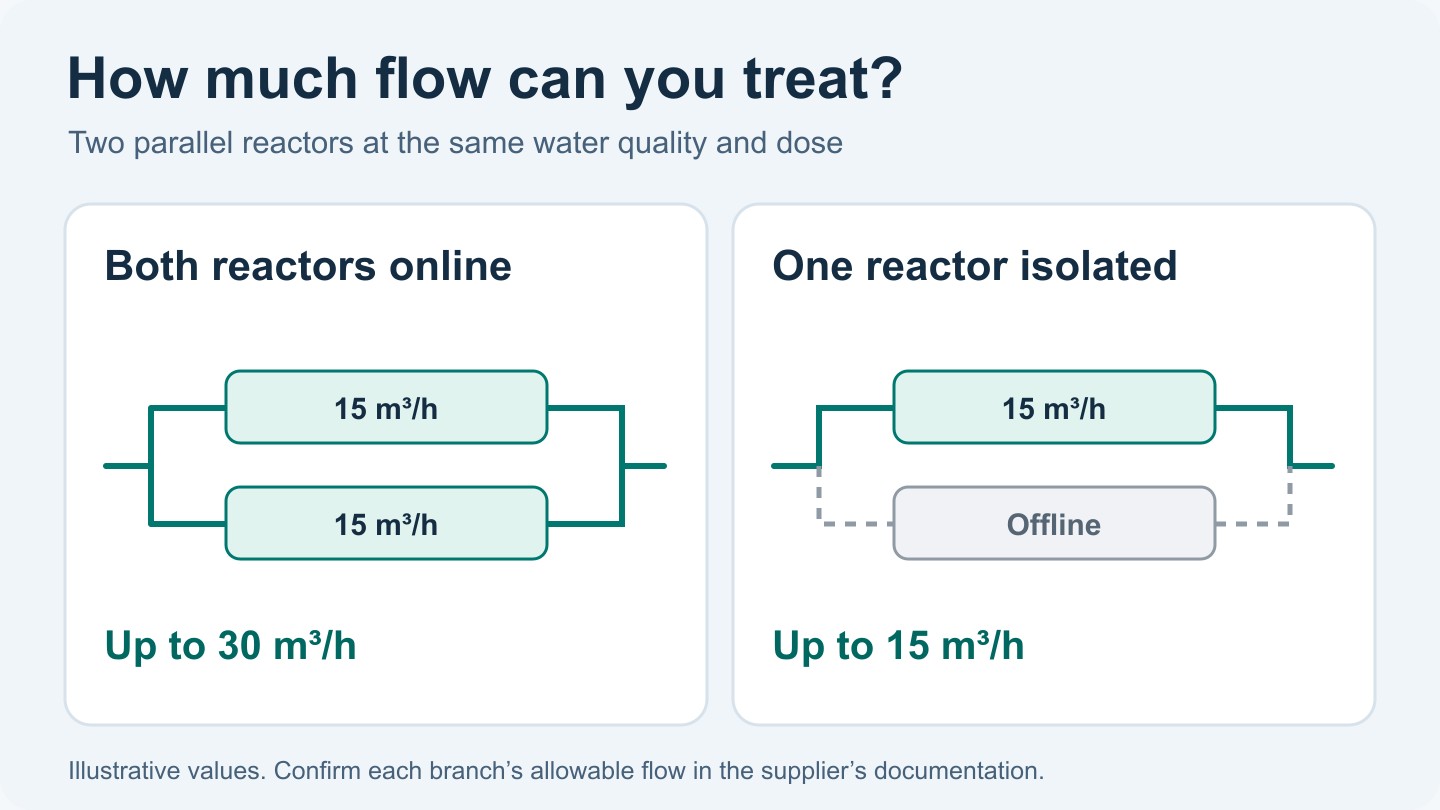
Two UV reactors rated at 15 m³/h each may cover a 30 m³/h peak when both are running. Take one offline for a lamp change and, at the same design conditions, the remaining reactor can treat up to 15 m³/h. If your operation still needs 30 m³/h during maintenance, make that requirement explicit when comparing commercial UV water treatment systems.
Put both operating cases on the quote
Start with the highest flow the plant must actually sustain while the largest reactor is out of service. It may be lower than the normal peak if the plant can reliably cut demand or schedule a shutdown. The British Columbia drinking-water guidance uses the largest reactor shutdown as a redundancy check for continuous-flow facilities. B.C. Ministry of Health, equipment redundancy, p. 22.
| Operating case | Capacity in this example | What it means for this quote |
|---|---|---|
| Both reactors online | Up to 30 m³/h, with 15 m³/h in each branch | The design meets the peak if the system can maintain that flow split. |
| One reactor isolated | Up to 15 m³/h in the remaining branch | If maintenance demand stays at 30 m³/h, the quote leaves a 15 m³/h shortfall. |
Compare both capacities at the same water quality and dose
Ask for the allowable flow of each quoted reactor at the project’s minimum UV transmittance (UVT) and required UV dose, with the test or validation conditions that support the figure. Then ask how the system will measure and limit the flow through each operating branch. With both branches online, even a total of 30 m³/h can overload one reactor if the flows are 17 and 13 m³/h. With a branch isolated, the controls must still keep the remaining reactor within its documented operating limits. The EPA toolkit covers reactor-level flow measurement, isolation and UVT in its hydraulic and design guidance. U.S. EPA UV Treatment Toolkit, p. 14.
Give bidders two separate numbers, normal peak flow and minimum treated-water flow during maintenance. If the quoted layout cannot meet the second number, ask the bidder to price standby treatment capacity or show what verified demand reduction the quote assumes. A raw-water bypass does not count as treated capacity.
When requesting a BIOSUN UV water system quote, send both flow requirements, the design UVT and the specified dose so the supplier can document capacity in each operating case.