
Nov 18, 2026
UV Light for Air Handlers: Coil Treatment vs Air Disinfection
Specify UV light for air handlers by separating coil-surface duty from airstream disinfection and matching test evidence to the proposed equipment layout.
Choosing UV light for an air handler starts with a question that lamp wattage cannot answer: is the equipment intended to treat coil surfaces, microorganisms carried in the airstream, or both? Those duties call for different evidence. A surface irradiance result should not become an airborne-inactivation claim simply because the same lamp is mounted inside an AHU.
For OEM equipment manufacturers and commercial engineering integrators, this distinction belongs in the technical brief before comparing lamp arrangements or quotations. This article explains how to separate the two duties and review the documents offered for each.
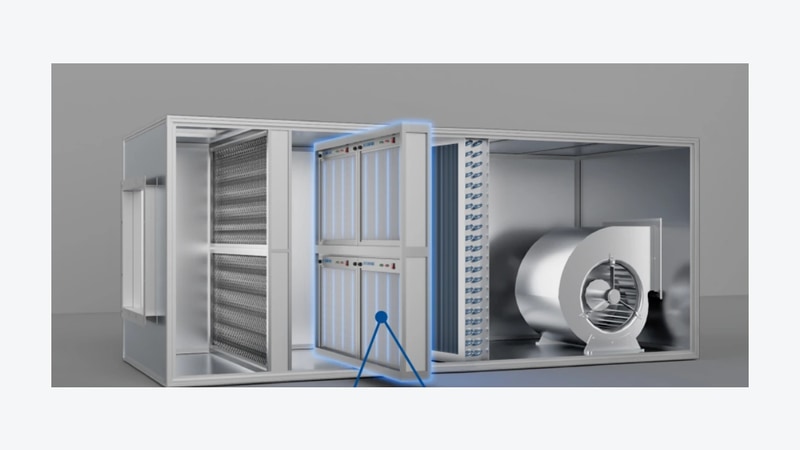
Define the Treatment Duty Before Comparing Hardware
For a coil-surface project, identify the surfaces to be irradiated and the geometry that could prevent light from reaching them. For an airstream project, identify the moving-air conditions and the performance objective to be evaluated. If the proposal covers both, ask the supplier to explain how each duty is supported rather than accepting a single combined efficacy statement.
| Procurement question | Coil-surface duty | Airstream duty |
|---|---|---|
| What is being treated? | Specified coil or other interior surfaces | Microorganisms carried through the treatment zone |
| What layout information is needed? | Surface dimensions, lamp position and obstructions | AHU cross-section, treatment section and operating airflow range |
| What evidence should be examined? | Surface irradiance information and the stated surface-treatment assessment | Airborne-inactivation results with test airflow and other conditions identified |
| What must not be assumed? | A measured surface intensity proves a particular reduction in passing air | An airstream test establishes coverage of every coil surface |
The BIOSUN HVAC equipment range includes equipment forms for different integration spaces. Selecting a physical form is only the first step; the project still needs evidence for its intended duty.
Read the Test Scope, Not Only the Standard Number
ASHRAE's public Handbook chapter on ultraviolet treatment describes two relevant methods. Standard 185.1 evaluates inactivation of airborne microorganisms in general ventilation systems. Standard 185.2 measures ultraviolet intensity on surfaces under HVAC&R operating conditions.
That is an important purchasing distinction: an irradiance measurement is not itself a measured microbial reduction. When reviewing a surface-treatment claim, ask what additional evidence supports the claimed outcome. When reviewing an airborne claim, ask for the actual test result and its conditions, not just a statement that a lamp was tested.
These descriptions come from a publicly readable Handbook discussion, not the full current standards or an assertion that they have been applied to a BIOSUN model. Neither a link to a standard nor a mention of its number proves certification, conformity or performance of the proposed equipment.
Keep Each Report Attached to the Configuration Tested
Check the report identity, model or assembly reference, lamp arrangement, operating conditions and measured result. Record the version of the proposed equipment beside the version tested. If the supplier proposes a different lamp arrangement or changes the installation geometry, request a written explanation of what evidence remains applicable.
Use a simple evidence register with separate entries for surface irradiance, any surface biological assessment and any airborne-inactivation test. This makes missing evidence visible without treating unlike measurements as interchangeable.
Why an AHU Location Does Not Establish Exposure
An AHU contains surfaces that remain in place and air that moves through it. The ASHRAE Handbook chapter on ultraviolet air and surface treatment identifies exposure time as a key difference between surface treatment and airborne inactivation. Moving air can pass through the irradiated section quickly, so a lamp arrangement must be assessed for that duty rather than judged by appearance alone.
For the buyer, the practical next step is to compare the proposed layout with the layout underlying the supporting data. Identify lamp positions, the treatment section, the relevant coil face and intervening structures. Ask which operating cases have been assessed and which remain assumptions. A drawing showing lamps near a coil is not, by itself, an airstream performance report.
Do not specify one universal lamp spacing or a fixed number of lamps per AHU. Those values need to come from the selected equipment's design and applicable assessment, not a number borrowed from another brand's manual.
Compare Like-for-Like Operating Conditions
Ask suppliers to state the test or selection conditions in a comparison sheet. For an airstream proposal, include the airflow and the relevant air conditions, target organism, test arrangement and reported endpoint. Clarify whether the result describes a single pass through the equipment or a different test arrangement.
For a surface proposal, identify the measurement locations, lamp-to-surface geometry and conditions used. If a report gives one reading at one position, do not interpret it as proof of uniform coverage over an entire coil. Ask for the assessed area and the limits of the result.
Separate lamp electrical input, UV output and irradiance at a surface. They are different quantities. An equal electrical wattage does not establish equal performance of two assemblies. The UV air-duct lamp selection guide addresses the broader mechanical and lamp-matching questions; this evidence comparison should accompany that work rather than replace it.
Check Service Access and Material Exposure as Separate Requirements
Treatment performance does not remove the need for an equipment safety and maintenance review. Ask how qualified personnel will isolate the UV equipment, access the lamps and verify the intended protective functions without exposure. Include nearby plastics, cable jackets, filters and other materials in the review.
As a model-specific reference, Honeywell's UVL-COIL product data, document 31-00402-02 identifies its AHU product as a surface-disinfection system, includes layout guidance and warns about UV exposure and material degradation. Its lamp spacings, electrical values and approvals belong to that product; they are not BIOSUN installation specifications.
At procurement stage, define who supplies the access protection, wiring documentation, maintenance instructions and safety assessment for the complete AHU. This article is not a wiring or installation procedure. Follow the approved documentation and qualified engineering review for the selected equipment.
Make the Purchase Decision Traceable
Before accepting a quotation, the decision record should answer three questions:
- What duty is being purchased? Coil-surface treatment, airstream disinfection or separately supported combined duties.
- What evidence supports it? Exact documents, applicable configuration, operating conditions and limitations.
- What remains to be confirmed? Layout changes, sample evaluation, control interfaces and finished-equipment safety responsibilities.
If only a surface measurement is available, record that limitation rather than describing the equipment as proven for airborne inactivation. If a report covers another model or arrangement, do not transfer the result without a documented basis.
Send the AHU layout and intended treatment duty through the BIOSUN project inquiry page. Ask for the documents applicable to the proposed configuration so the purchasing and engineering teams can review the same evidence before release.