9 月 1, 2026
UV Lamp Private Label and Model Marking Guide for OEM Buyers
A practical OEM buyer guide to UV lamp private label and model marking, covering traceability, sample approval, packaging labels and repeat order accuracy.
For OEM buyers and distributors, UV lamp private label marking is not only a branding detail. It is a practical control point for repeat orders, after-sales replacement, traceability and warehouse picking accuracy. When a buyer sources UV germicidal lamp tubes or compatible replacement UVC lamps, the printed model code, production batch and packaging label must match the approved specification, not just the lamp size.
Why private label marking matters in UV lamp procurement
Many UV lamps look similar at first glance: clear quartz glass, ceramic bases, pin terminals and comparable wattage markings. In real replacement work, however, one wrong model mark can lead to incorrect ballast matching, wrong lamp length, order disputes or service delays. A clear private label system helps overseas buyers connect the lamp on the shelf with the original purchase order, approved sample and customer equipment list.
Before confirming bulk production, buyers should define the same model information that appears in their internal catalog, service manual and future replenishment order. A useful starting point is to review the fields in a UV lamp specification sheet checklist, then convert the final model data into a simple marking and label rule.
What information should appear on the lamp body?
The lamp body should carry enough information for identification, but it should stay concise. Overly long printed text can be difficult to read on a round glass tube and may not survive handling or cleaning. For most OEM and distributor orders, the lamp marking should include the private model code, wattage, lamp type or wavelength family, and a production batch reference.
Private model code
The private model code is the buyer-facing item number. It can follow the buyer’s own catalog system or a custom BIOSUN-supported format. During sample approval, confirm that the code on the lamp body matches the code on the outer carton, packing list and future invoice description.
Electrical and lamp type information
Where space allows, include wattage and lamp type information to reduce service mistakes. This is especially helpful when the buyer supplies both standard low-pressure lamps and high-output or amalgam UV lamps to different projects.
Batch or date code
A batch code gives both sides a faster way to trace production records if a field issue appears later. It also helps buyers rotate stock and compare lamp performance by shipment batch.
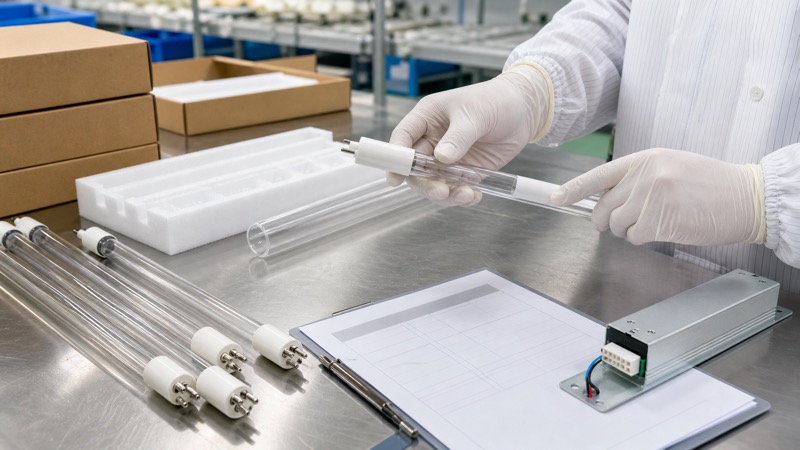
Marking method and durability checks
The correct marking method depends on lamp glass, printing position, order volume and the operating environment. The mark should remain readable after normal packaging, unpacking, installation and warehouse handling. For lamps installed in water treatment systems, buyers should also consider moisture, cleaning chemicals and contact with gloves or sleeves during maintenance.
When a lamp is supplied with a quartz sleeve, check that the mark remains visible enough for identification after installation. If the mark will be hidden inside the chamber, the carton label and maintenance record become even more important.
Packaging labels should follow the same rule
The lamp body mark is only one part of the private label system. Each inner box and export carton should use the same model code, quantity, batch reference and handling marks agreed during sample approval. This prevents warehouse teams from mixing similar lamps and makes it easier to match replacement parts when a distributor carries several related models.
For fragile UV lamps, label accuracy should be combined with protective packing. The principles in BIOSUN’s UV lamp packaging and shipping guide are useful when planning inner foam, separators, carton strength and export shipment checks.
Connect marking approval with the sample approval process
Private label marking should be approved together with the physical sample, not after production has started. The buyer should confirm a marked lamp sample, a carton label sample and the final product specification sheet in one approval record. This reduces disagreement later about whether the delivered mark, code position or label wording is correct.
BIOSUN usually recommends that buyers keep photos of the approved sample, marking area and packaging label. This follows the same control logic explained in the UV lamp sample approval guide: the more clearly the approval record is defined, the easier it is to repeat the same lamp in future orders.
How private marking supports replacement model matching
Private label control is especially valuable for distributors that sell replacement lamps into existing UV systems. A service team may not know the original lamp factory, but they can photograph the private model code and send it for matching. BIOSUN can then compare lamp length, diameter, base type, pin layout, wattage and ballast requirement before recommending a replacement.
If the lamp is part of a larger kit, buyers should also align the marking rules for UV lamp accessories, lamp holders, sleeves and cable components. For electronic control parts, keep cross-reference records with compatible UV electronic ballasts so a replacement request does not stop at the lamp code only.
Checklist before bulk production
Confirm the exact printed content
List the model code, wattage, lamp family and batch format before production. Avoid changing code format between sample order and bulk order unless both sides update the approval record.
Check print position and readability
Ask for clear sample photos from multiple angles. The mark should be readable without rotating the lamp many times or removing protective packaging unnecessarily.
Match lamp, inner box and carton labels
Make sure the same private model code appears across the lamp, box, carton label and purchase documents. This is one of the easiest ways to prevent repeat-order mistakes.
Keep a spare-parts control table
For distributors and service companies, connect the private model code with related sleeves, ballasts and holders in a spare-parts table. The UV lamp spare parts stocking guide gives a practical structure for building that list.
FAQ
Can BIOSUN print our private model code on UV lamps?
Yes. BIOSUN can support OEM model marking for suitable UV lamp orders. The buyer should provide the exact code format, approved wording and label requirements before sample confirmation.
Should the private label include the buyer’s brand name?
It depends on the buyer’s distribution strategy. Some buyers use only a private model code, while others include a brand name on packaging and keep the lamp body more technical. The best choice is the one that reduces service confusion and supports repeat orders.
What should we send for model marking confirmation?
Send the target lamp specification, expected model code, packaging label requirements, annual quantity estimate and any existing sample photos. If you are not sure about compatibility, contact BIOSUN through the UV lamp inquiry page with lamp photos and system details.
Send your OEM marking requirements to BIOSUN
BIOSUN supports OEM and replacement UV lamp buyers with model matching, sample approval, private label marking and export packaging. Share your lamp drawing, existing model number, wattage, base photos and target order quantity through the contact page, and the BIOSUN team can help prepare a practical marking and production proposal.
Need a UV lamp quotation?
Send your model list to Baiousen and we will review the lamp matching details by email.
Send Inquiry