Jul 3, 2026
OEM UV Lamp Customization Guide for Equipment Manufacturers
A practical OEM UV lamp customization guide for equipment manufacturers covering lamp shape, wattage, wavelength, base type, ballast matching, drawings, samples and production checks.
OEM UV lamp customization is different from buying a standard replacement lamp. For equipment manufacturers, the lamp must fit the mechanical structure, electrical system, disinfection target, safety design and production plan. A lamp that looks correct but uses the wrong base, arc length, wattage or ballast requirement can create installation problems during assembly or field maintenance.
This guide is written for overseas B2B buyers, appliance brands, air purifier manufacturers, water sterilizer builders and commercial disinfection equipment companies that need customized UV germicidal lamps for OEM or ODM projects.
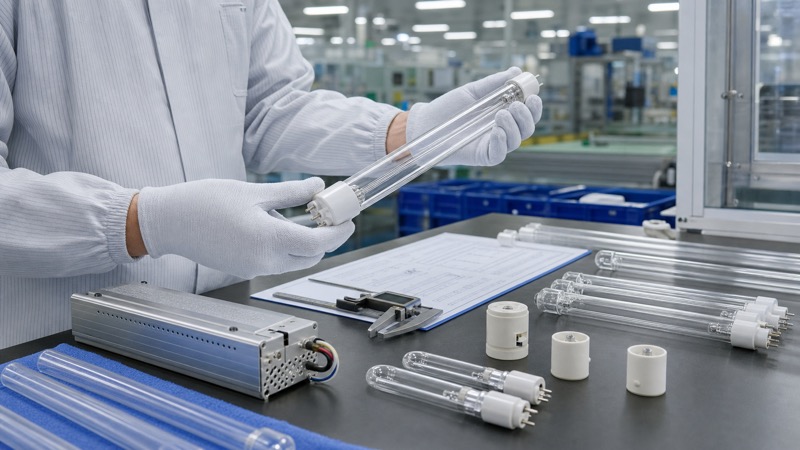
Quick Answer: What Should Buyers Prepare for an OEM UV Lamp Project?
For a fast technical review, prepare the target application, lamp drawing or installation space, expected wavelength, lamp shape, wattage range, base type, operating voltage, ballast requirement, quantity forecast and any safety or certification requirements. If the project replaces an existing lamp, send the old lamp code, photos, total length, tube diameter and base photos.
| OEM Item | Why It Matters | What to Confirm |
|---|---|---|
| Application | Water, air, surface and appliance projects use different lamp layouts. | Equipment type, installation position and target use environment. |
| Lamp structure | Shape, length, base and wire position decide whether the lamp fits. | Straight, U-shaped, H-type or cold cathode design with drawings. |
| Wavelength | Ozone-free and ozone-generating lamps serve different project goals. | 254 nm, 185/254 nm, ozone-free or special requirement. |
| Ballast matching | The lamp and ballast must work as one electrical system. | Lamp power, input voltage, wiring, ignition and lifetime target. |
1. Start With the Equipment Application
The application decides the right customization direction. A UV water sterilizer usually needs straight lamp tubes installed inside quartz sleeves. Air purifiers, HVAC modules and appliance projects may need compact U-shaped, H-type or cold cathode lamp structures. Surface treatment and packaging equipment may require longer exposure areas or multiple lamp positions.
Before discussing model codes, buyers should explain where the lamp will be installed, how much space is available, whether the product is for indoor air, water, surface or appliance disinfection, and whether the lamp will be serviced by end users or technicians.
2. Choose the Lamp Shape and Mechanical Structure
BIOSUN supports several UV lamp structures for OEM projects, including straight hot cathode lamps, U-shaped lamps, H-type lamps and compact cold cathode lamps. Each structure has different requirements for tube length, base position, wire routing, lamp holder and protection design.
If the project can use an existing platform, buyers can start from the UV germicidal lamp tubes page and request small adjustments. If the equipment requires a special shape or base, drawings and installation photos help the engineering team confirm feasibility more quickly.
3. Confirm Wavelength: Ozone-Free or Ozone-Generating
Many UV germicidal applications use 254 nm UV-C lamps. Some projects require 185/254 nm ozone-generating lamps for stronger oxidation or odor treatment, while many indoor appliance and air disinfection products require ozone-free designs for safer operation.
Buyers should not leave wavelength as an open detail until sample production. The wavelength decision affects glass material, safety instructions, application design and how the finished equipment should be marketed to customers.
4. Match the Lamp With the Electronic Ballast
The UV lamp and ballast should be selected together. A customized lamp may need a matching output current, ignition voltage and wiring layout. If the ballast is not matched correctly, the lamp may fail to start, flicker, run at unstable output or have reduced life.
For new equipment development, review the lamp and UV electronic ballast as one system. If the customer already has a ballast supplier, share the ballast label and technical data before sample confirmation.
5. Define Base Type, Wire Length and Installation Details
Base type is a common source of OEM mismatch. A lamp may use a standard base, ceramic base, special cap, wire lead, plug connector or custom holder. Wire length and connector orientation also affect assembly efficiency inside the finished equipment.
For replacement-oriented OEM projects, check the replacement UVC lamps range and compare base photos with the installed lamp. For new designs, buyers should confirm lamp holder, cap space, service access and whether the lamp will be replaced by professional maintenance teams.
6. Plan Samples Before Batch Production
OEM UV lamp projects should move through drawing confirmation, sample production, sample testing and batch approval. During sample review, buyers should check mechanical fit, starting performance, heat behavior, UV output requirement, packaging and labeling needs.
If the project includes other parts, combine the lamp sample with UV lamp accessories such as lamp holders, caps, O-rings, connectors and protective parts. This helps avoid a situation where the lamp is correct but the surrounding installation parts are incomplete.
7. Quality and Documentation for B2B Buyers
For long-term sourcing, buyers should keep a simple specification record for each customized lamp. Useful details include drawing version, lamp power, tube length, wavelength, base material, wire length, ballast model, sample approval date and production batch notes.
For company qualification review, buyers can also check the BIOSUN certificate page and confirm which test documents or compliance materials are relevant to the target market. Certification needs should be discussed early because they may affect product design and documentation.
8. Buyer Checklist for an OEM UV Lamp Inquiry
- Target application and equipment photos
- Lamp drawing or available installation space
- Required lamp shape, length, diameter and base type
- Wavelength requirement: 254 nm, 185/254 nm or ozone-free
- Wattage range, voltage and ballast information
- Expected annual quantity and sample quantity
- Packaging, labeling and documentation needs
- Destination market and any safety or certificate requirements
Common Questions About OEM UV Lamp Customization
Can BIOSUN customize a lamp from a drawing?
Yes. A drawing, sample photo or detailed dimension list helps confirm whether the lamp can be produced directly or should be adjusted for safer manufacturing and better matching.
Can one lamp be used for both water and air disinfection?
Sometimes the lamp technology may be similar, but the installation structure and safety design are usually different. Water systems need quartz sleeve matching, while air systems require shielding, airflow and user-safety review.
What is the usual first step for a new OEM project?
The first step is technical matching: application, lamp shape, size, wavelength, ballast and installation space. After that, buyers can move to sample confirmation and batch quotation.
Summary
OEM UV lamp customization should be handled as a complete system, not only as a lamp tube order. The safest process is to confirm application, lamp structure, wavelength, ballast, base type, installation details and sample testing before batch production.
For OEM or ODM UV lamp projects, send your drawings, photos or specification list through the BIOSUN inquiry page. BIOSUN can review standard and customized UV lamp options for water sterilizers, air disinfection equipment, appliances and commercial purification systems.
Need a UV product quotation?
Send the model, drawing, application and expected quantity. BIOSUN will review the matching details and reply by email.
Send Inquiry